
The Wedding DJ's Eternal Dilemma
We've all been there: You're two hours into a wedding reception. The dance floor is packed. You've perfectly read the room, transitioning from Motown classics to modern chart-toppers. Then Uncle Barry appears at your booth—again—with his phone screen glowing, ready to request "Wonderwall" for the fourth time tonight.
Sound familiar?
Welcome to wedding DJing in 2026, where managing song requests is less about saying "no" and more about saying "I'll get to it" in increasingly creative ways. But here's the thing: song requests aren't your enemy. In fact, they're one of the best tools for keeping guests engaged—if you handle them properly.
The Modern Wedding Request Landscape
Let's start with some data. According to industry research, the average 100-person wedding reception generates 15-30 song requests throughout the night. That's one request every 10-15 minutes during peak hours. and that's not thinking about the list the happy couple gave you 2 months ago.
In 2026, guests expect:
- Instant gratification (they've been requesting songs since 2010)
- Transparency (they want to know if you got their request)
- Control (even though you're the expert, they know better)
The challenge? Balancing these expectations with your professional judgment while maintaining the energy on the dance floor.
Why Traditional Request Management Fails
The Napkin Method
Remember when guests wrote requests on serviettes? Yeah, neither do they. Napkins get lost, handwriting is illegible, and you can't read a crumpled paper while beatmatching.
The "Shout Over the Music" Approach
Possibly the worst. The guest has to compete with the celebration itself, you can't hear them, they get frustrated, you lose 30 seconds of focus, and someone inevitably requests a song you played 10 minutes ago.
The "Come to the Booth" Queue
This turns your DJ setup into a customer service counter at the post office. Five people deep, all clutching phones, all convinced their request is the most important. Meanwhile, the dance floor energy drops because you're distracted.
The 2026 Solution: QR Code Request Systems
Here's where modern technology saves the day (and your sanity). QR code request systems have transformed how professional DJs manage song requests.

How It Works:
- Couple shares a QR code (table cards, projected on screens, included in invitations)
- Guests scan with their phones
- They submit requests instantly
- You see all requests in real-time on your DJ dashboard
- Duplicate detection prevents "Wonderwall" x 4
- You maintain full control over what plays and when
Why This Works:
For Guests:
- No awkward booth interruptions
- Submit from their seats, the dance floor (or in advance)
- Instant confirmation their request was received
- Can add messages/dedications
For You:
- See all requests at a glance
- Automatic duplicate filtering
- Queue management tools
- Play/skip tracking for analytics
- No physical interruptions during transitions
Best Practices for Wedding Request Management
1. Set Expectations Early
Work with the couple during planning:
- Explain your request policy (suggestions vs. commands)
- Agree on "do not play" lists
- Clarify your approach: curator, not jukebox
Script for couples:
"I take requests as suggestions to gauge the room's energy. If 10 people request '80s classics, I know that's the vibe. But I won't play a death metal song during the cake cutting, even if someone requests it. You're hiring me for my expertise—think of requests as helpful data, not commands."
2. The 70/30 Rule
- 70% your curation (songs you know will work based on the room)
- 30% requests (popular suggestions that fit the vibe)
This keeps you in control while making guests feel heard.
3. Manage the Queue Strategically
Not all requests are created equal:
Play Immediately:
- Bride/groom requests (obviously)
- Songs that fit the current energy perfectly
- High-request songs with multiple duplicates
Play Later:
- Genre shifts that need setup (can't go from hip-hop to country ballad)
- Songs that work better at specific times (slow songs after high energy)
- Requests from guests who've had... a few drinks
Diplomatically Decline:
- Explicit lyrics during family moments
- Songs on the couple's "do not play" list
- Vibe killers (we all know which songs these are)
4. Use Technology to Your Advantage
Modern QR code request systems offer features that make your life easier:

Duplicate Detection:
When the third person requests "Uptown Funk," the system groups them together. You're not managing 47 individual requests—you're managing 15 unique songs with popularity indicators.
Request Notes:
See why guests are requesting songs. "For Grandma's 90th birthday" hits different than "because I'm drunk."
Time Stamps:
See when requests come in. A surge of ballad requests at 11 PM? The crowd's getting tired. Adjust accordingly.
Auto-Refresh Dashboard:
30-second updates mean you always know what's coming without stopping your flow.
Common Wedding Request Scenarios (And How to Handle Them)
Scenario 1: The Drunk Uncle
The Request: "Sweet Caroline" (for the 5th time)
Traditional Handling: Nod, smile, say "I'll get to it," hope he forgets.
2026 Handling: Your duplicate detection shows you he's already requested it 4 times. You can see exactly when you played it (9:47 PM). You politely message back via the system: "Already played at 9:47—crowd loved it! Have another request?"
Scenario 2: The Genre Whiplash
The Request: Country line dancing song immediately after Dua Lipa
Traditional Handling: Awkward transition that clears the floor.
2026 Handling: Queue it for after the next slow dance when you can reset the energy. Your dashboard shows you have 3 other country requests—group them together for a mini-set later.
Scenario 3: The Inappropriate Request
The Request: Explicit hip-hop during the father-daughter dance
Traditional Handling: Try to explain why it's inappropriate while Uncle Barry argues.
2026 Handling: Skip it in the system with a note. No confrontation needed. Barry gets a gentle automated message: "Thanks for the request! Saved for later in the evening."
Scenario 4: The Obscure Deep Cut
The Request: A song you've never heard of from a band that broke up in 1987
Traditional Handling: Fake recognition, promise to "check if you have it," never follow up.
2026 Handling: Quick Spotify/Apple Music search from your phone while the current song plays. If it fits the vibe and you can mix it, great! If not, mark it as "unavailable" with a suggestion for something similar.
The Psychology of Request Management
Here's a secret: Most guests don't actually care if you play their request.
What they care about is feeling heard.
Think about it:
- They scan a QR code
- Submit a request
- Get instant confirmation
- See it appear in the queue
Even if you never play "Africa" by Toto (though let's be honest, you probably will), they got the dopamine hit of participating. They influenced the night. They're engaged.
This is why modern systems work: The technology handles the emotional labor of acknowledgment while you handle the actual DJing.
Setting Up Your Request System
Before the Event:
- Create unique QR codes for the couple
- Test the system (have friends submit requests, practice queue management)
- Share QR code with couple for table cards/signage
- Brief the couple on how it works
During Setup:
5. Ensure you have stable WiFi/mobile data
6. Position tablet/phone for easy dashboard viewing
7. Set up backup plan (pen and paper, just in case)
During the Event:
8. Monitor dashboard during natural breaks (slow songs, dinner)
9. Adjust queue based on room energy
10. Use request data to inform next song choice
Pro tip: Some DJs project their request dashboard on a screen so guests can see the queue. This transparency builds trust—and reduces repeat requests because people can literally see their song is queued.
When NOT to Take Requests
Not every wedding needs a wide-open request policy. Consider limiting or closing requests during:
- Ceremony processional/recessional (couple has usually planned this)
- First dance (obviously)
- Special dances (father-daughter, mother-son, etc.)
- Dinner service (you've curated background music for a reason)
- Key moments (cake cutting, bouquet toss)
Lock the request form during these moments and communicate why: "Request form will reopen after the cake cutting!" Guests understand and respect the structure.
Measuring Success
How do you know your request management is working?
Good Signs:
- Dance floor stays packed
- Minimal booth interruptions
- Guests commenting "The music was perfect!"
- Variety in requests (shows broad engagement)
- Couple books you for their friends' weddings
Warning Signs:
- Guests abandoning the dance floor
- Multiple people asking "Did you get my request?"
- Couple looking confused by song choices
- All requests from the same 3 people
Real DJ Success Stories

Sarah, Cork Wedding DJ:
"I used to get interrupted every 2 minutes. Now I glance at my tablet during transitions, queue up popular requests, and actually focus on my mixing. My last bride said 'Everyone felt heard but you stayed in control—perfect balance.'"
Michael, Dublin Mobile DJ:
"The duplicate detection is a game-changer. I can see 'Mr. Brightside' has 8 requests in 10 minutes—that's my cue to play it. Instead of individual pressure, I'm reading aggregate data. Much better decisions."
Emma, Galway Event DJ:
"I love that guests can see I received their request without me having to nod and smile 50 times a night. The system does the emotional labor so I can do the actual work."
The Bottom Line
Wedding song request management in 2026 isn't about being a human jukebox or a dictator DJ. It's about:
- Using technology to handle the logistics (submission, confirmation, queue management)
- Applying your expertise to curate the actual playlist
- Making guests feel heard without sacrificing dance floor energy
- Maintaining professionalism through systems, not confrontation
The couples who hire you in 2026 expect modern solutions. They've used QR codes for restaurant menus, wedding RSVPs, and payment systems. Extending that to song requests isn't just convenient—it's expected.
And for you? It means less time playing customer service and more time doing what you do best: reading the room, building energy, and creating unforgettable moments.
Ready to Modernize Your Request System?
CeolCode's QR request platform is built specifically for wedding DJs.
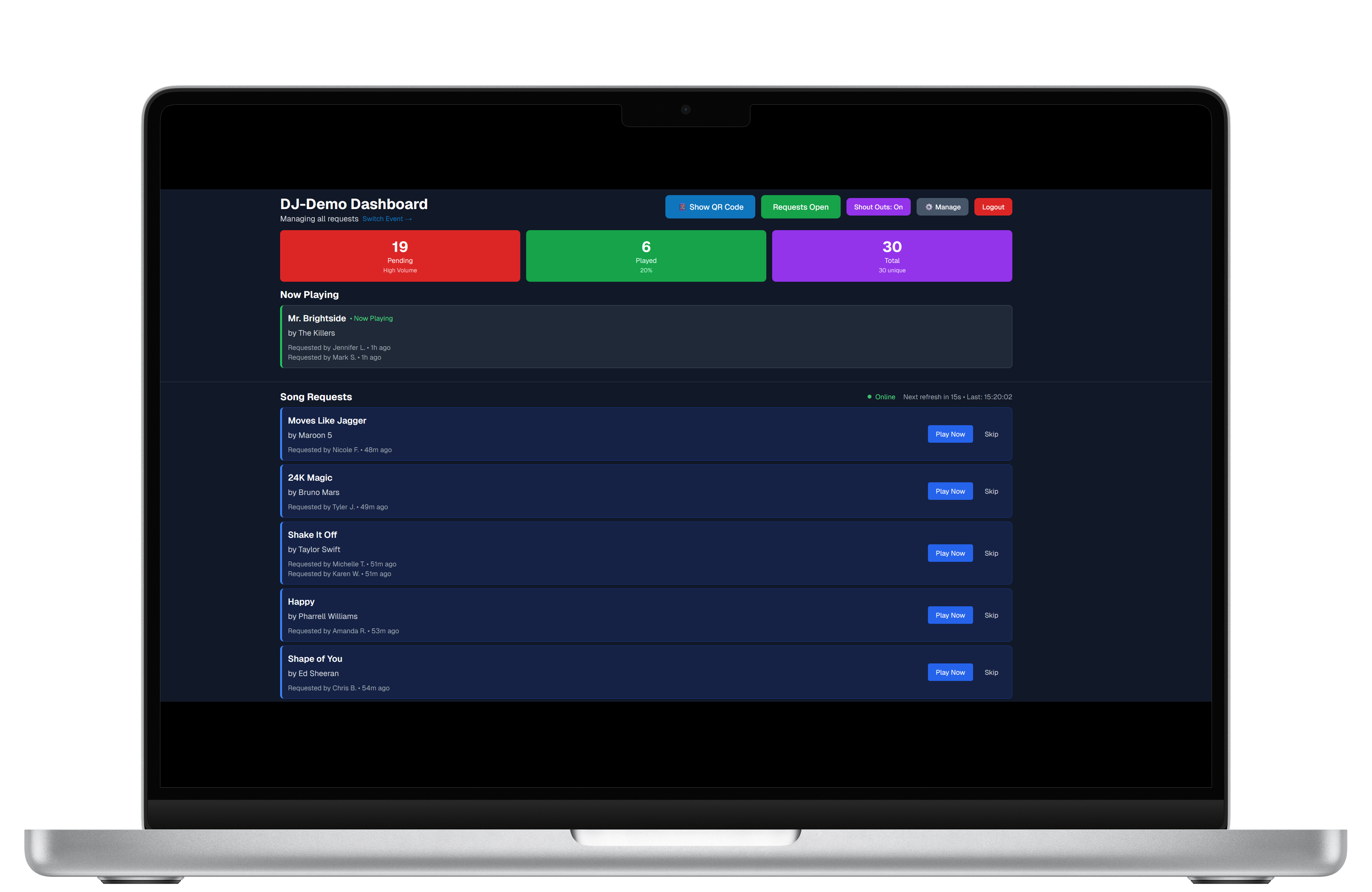
See it in action: Try the live demo dashboard — no signup required!
Features wedding DJs love:
- Unlimited requests per event
- Automatic duplicate detection
- Real-time dashboard with 30-second refresh
- Guest shoutout messages
- Play/skip tracking for post-event analytics
- Works offline (local storage backup)
Ready to upgrade your setup? Start your free trial today.
Because in 2026, your couples deserve more than a napkin pile, and you deserve more than Uncle Barry's 5th visit to your booth.
Related Reading: